
Clinical Research & Development
Home » Clinical Research & Development
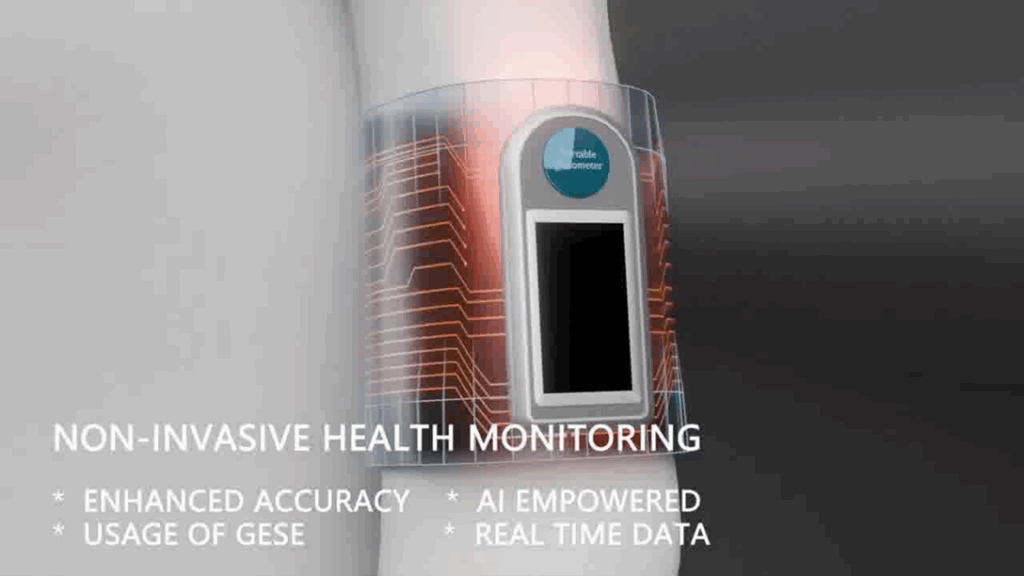
Advancing Science for Accurate, Non-Invasive Diabetes Management
At VitaSensor, our clinical research is driven by a commitment to scientific excellence and rigorous validation. Our research team continuously engages in comprehensive studies to validate our non-invasive glucose monitoring technology, positioning us for FDA clearance and setting new benchmarks in diabetes management.
Peer-Reviewed Research Publications
We maintain a steadfast dedication to transparency and scientific credibility, sharing our findings through peer-reviewed scientific literature. Each publication comprehensively documents our clinical study designs, methodologies, results, and interpretations, offering clear insights into VitaSensor’s performance compared to established glucose measurement standards.
Our publications present robust clinical data, ensuring that healthcare providers, industry experts, and users have full confidence in the safety, accuracy, and reliability of VitaSensor’s non-invasive monitoring capabilities.

Clinical Study Design and Methodologies
We employ a rigorous, multi-faceted clinical research approach to validate VitaSensor’s accuracy, consistency, and comfort across diverse physiological conditions. Our study design ensures robust testing, meaningful comparison, and clinically reliable outcomes.
Comprehensive Testing
Our clinical research measures glucose detection performance across a broad range of levels, including hypoglycemia, normoglycemia, and hyperglycemia.
Comparative Analysis
We conduct comprehensive comparative testing against conventional invasive monitoring methods, applying rigorous statistical analysis such as MARD.
Reproducibility
We emphasize reproducibility, consistency, and transparency in every study to meet strict clinical-grade research and validation requirements.
Advanced Algorithms and Analytical Excellence
Integral to our research are advanced machine-learning algorithms that process and interpret glucose data in real-time. We openly share details about our analytical methodologies, algorithm development, and refinement processes. This transparent approach highlights the sophisticated data science behind VitaSensor’s accurate glucose predictions, fostering trust among clinical professionals and end users.
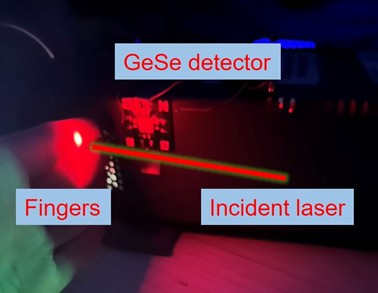
Advanced Algorithms and Analytical Excellence
VitaSensor actively collaborates with respected medical institutions, research organizations, and industry experts. These strategic partnerships facilitate robust clinical validation, accelerating technological advancements and enhancing the credibility and breadth of our clinical data.
Our collaborative approach promotes diverse insights, innovation, and widespread acceptance of VitaSensor within medical and scientific communities.
Medical Institutions
Research Organizations
Industry Experts
Clinical Validation
Open and Transparent Communication
We commit to clear and ongoing communication of our research activities, clinical outcomes, and technological advancements. Through professional journals, conferences, and open-access summaries, we consistently update the community about our progress toward FDA approval and broader market introduction.
VitaSensor’s transparent approach underscores our commitment to scientific integrity, clinical excellence, and meaningful innovation, ensuring our technology remains reliable, credible, and highly trusted.
Our Journey to Innovation:
VitaSensor’s development journey highlights our continuous innovation and dedication:
In 2022, VitaSensor was founded with the initial concept formulation. The following year, we successfully developed and validated our first prototype sensors. In 2024, we refined our advanced prototypes, submitted multiple patents, and received significant industry recognition. Moving forward, our focus remains on regulatory approval, commercialization, and ongoing technological advancements.
Awards and Recognitions
Our achievements reflect our commitment to excellence
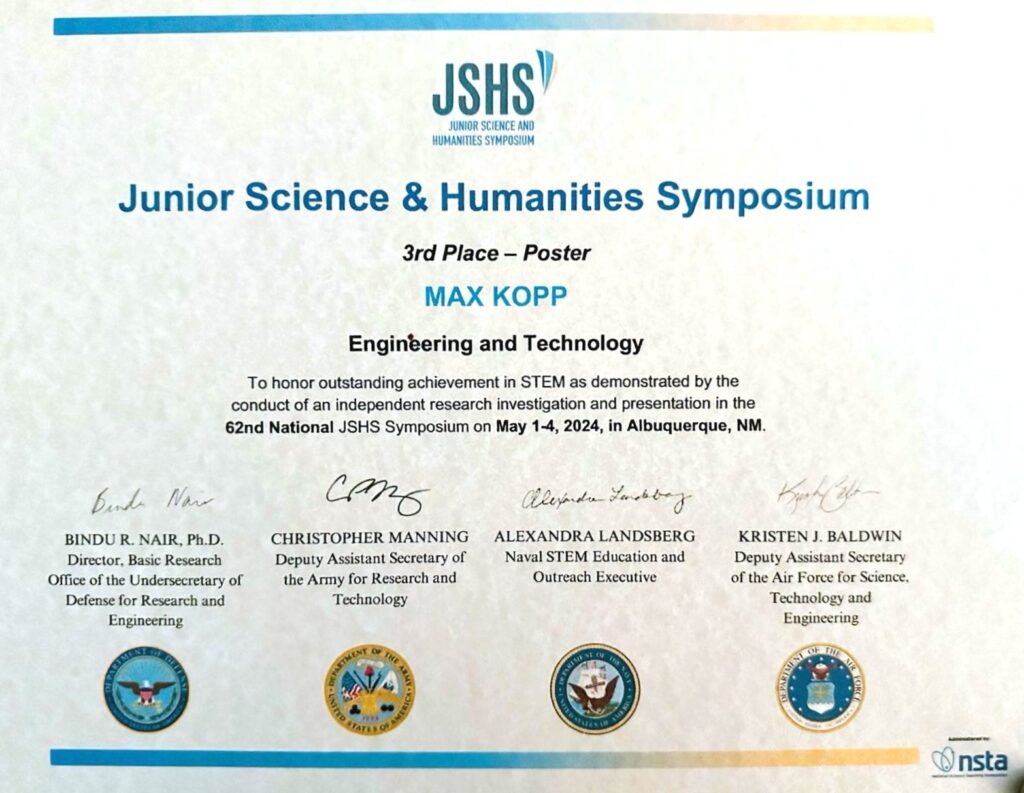
62nd NJSHS Scholarship and 3rd Place (2024)

S.T. Yau Highschool International Science Award (2024)
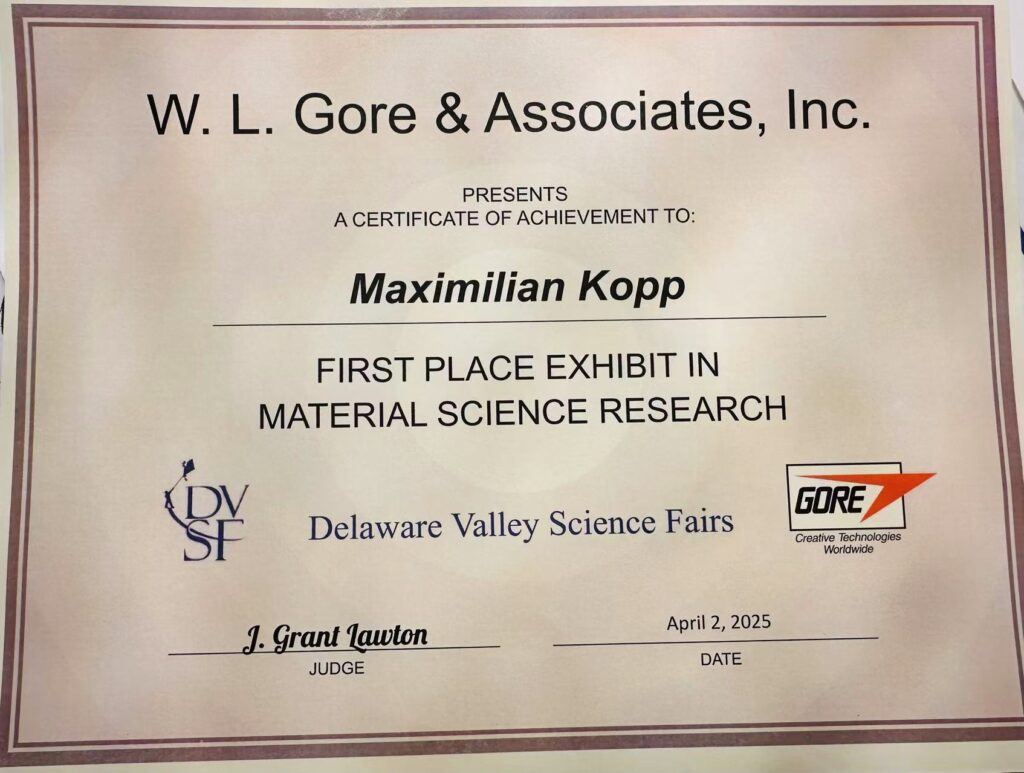
W.L. Gore & Associates Material First Award (2025)
Publication

Max Kopp has authored and published research papers on nanomaterials, sensor technology, and their applications. His notable work includes:
Analysis of the Polarized Photoresponse of GeSe and Its Application in Non-Invasive Blood Glucose Monitoring, which earned him a Bronze Medal at the S.-T. Yau High School Science Award (North America Division, 2024)
EWA:Flexible nanomaterial sensors for non-invasive health monitoring
Max is conducting a groundbreaking project focused on the development of ink-printed flexible sensors for structural defect detection. The project aims to enhance sensor durability, improve ink formulations, and achieve high sensitivity in extreme environments.Research Gate: Flexible nanomaterial sensors for non-invasive health monitoring
Inkjet-Printed Piezoelectric Nanomaterial Arrays for Autonomous Structural Health Monitoring in Spacecraft and Deep-Space Exploration.
This study presents an innovative, deployable inkjet-printed sensor array designed for real-time defect detection in spacecraft. The research focuses on leveraging piezoelectric nanomaterials for in-situ sensor fabrication, achieving sub-1% defect localization error and outperforming commercial ultrasonic sensors by 38% in sensitivity. The technology aims to enhance safety in long-duration space missions by enabling astronauts to fabricate and deploy sensors in microgravity environments.
Max’s Patents
We invite you to explore our comprehensive research publications and patent documentation, showcasing VitaSensor’s scientific credibility and technological advancements.
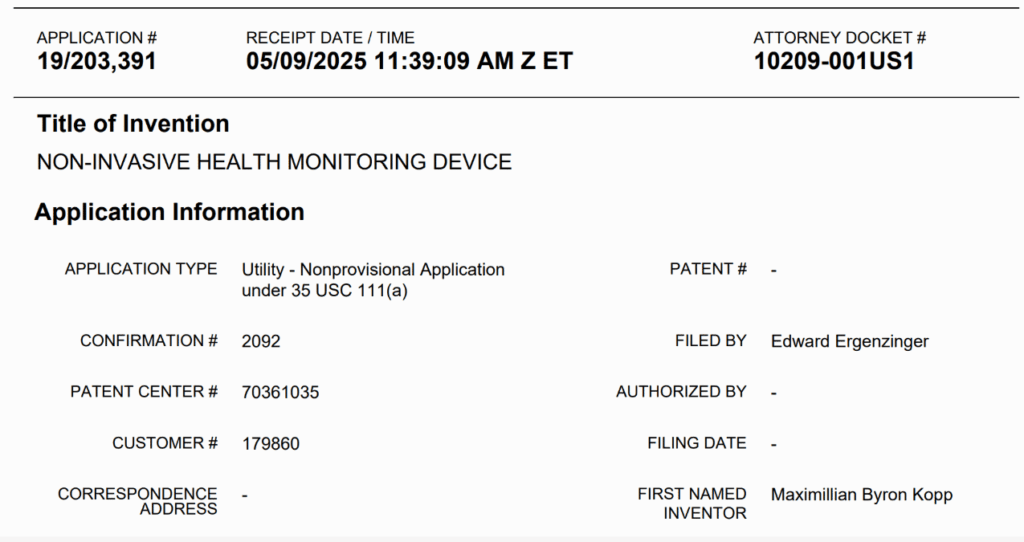
Kopp, M. B. (2025). Non-Invasive Health Monitoring Device Using Polarized Light and Nanomaterial-Based Optical Sensors (U.S. Utility Nonprovisional Patent Application No. 19/203,391). United States Patent and Trademark Office. Filed May 9, 2025. Confirmation No. 2092. Attorney Docket No. 10209-001US1. Application Type: Utility under 35 USC 111(a).
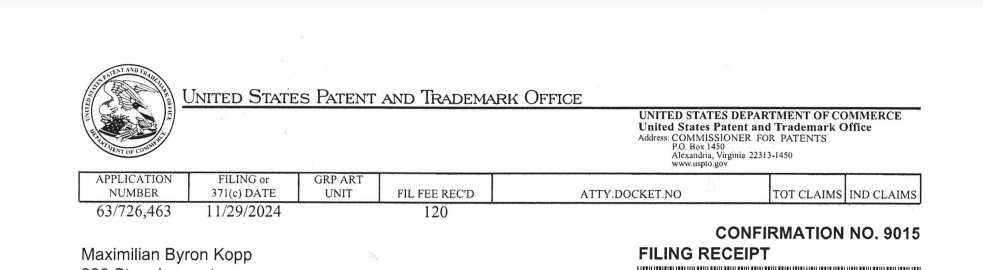
Kopp, M. B. (2024). Non-Invasive Glucose Monitoring System Using Polarized Light and Nanomaterial Sensors (U.S. Provisional Patent Application No. 63/726,463). United States Patent and Trademark Office. Filed November 29, 2024. Confirmation No. 9015.
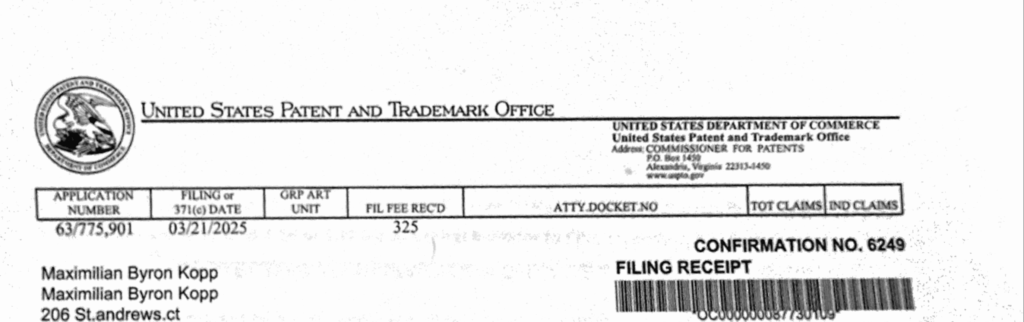
Kopp, M. B. (2025). Real-Time Structural Health Monitoring System for Spacecraft Using Inkjet-Printed Ultrasonic Sensors (U.S. Provisional Patent Application No. 63/775,901). United States Patent and Trademark Office. Filed March 21, 2025. Confirmation No. 6249.